Call for Abstracts
Abstract Submission Guidelines

e-Abstract Booklet
Abstracts from the APOCP 13th General Assembly & Scientific Conference, published in the Asian Pacific Journal of Cancer Prevention (APJCP).
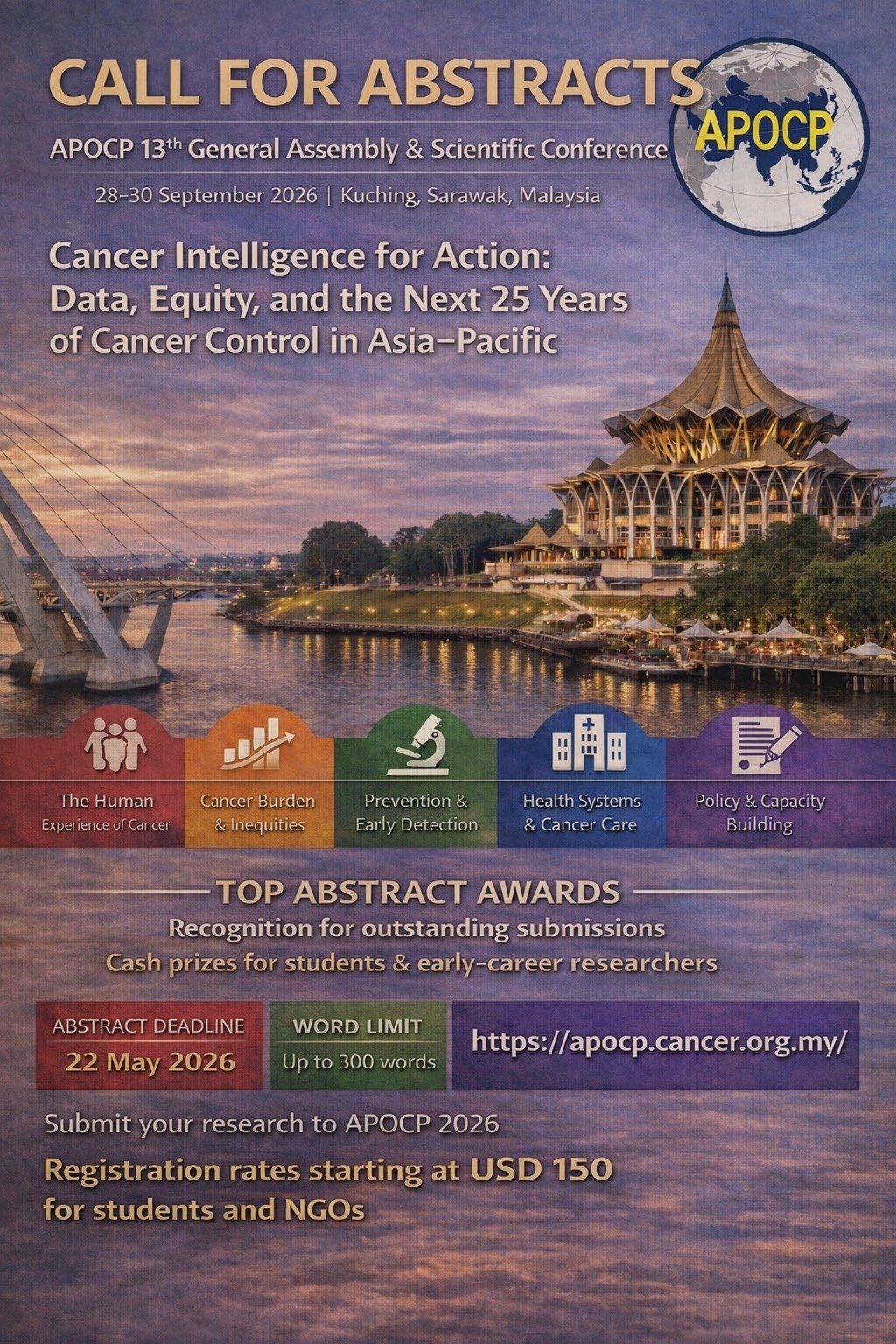
APOCP 13th General Assembly & Scientific Conference
Conference: 28–30 September 2026
Venue: The Waterfront Hotel, Kuching, Sarawak, Malaysia
Theme: Cancer Intelligence for Action: Data, Equity, and the Next 25 Years of Cancer Control in Asia-Pacific
The Asian Pacific Organization for Cancer Prevention (APOCP) invites the submission of abstracts for the 13th APOCP General Assembly & Scientific Conference, to be held from 28–30 September 2026 in Kuching, Sarawak, Malaysia.
Celebrating 25 years of APOCP, this landmark conference will bring together public health practitioners, clinicians, policymakers, advocates, civil society leaders and researchers to examine how cancer prevention and control can be future-ready, people-centred, and equity-driven across the Asia–Pacific region.
Abstracts presenting original research, policy analysis, implementation science, programme evaluations, and innovative practices are warmly welcomed.
Submission Process
- All abstracts must be submitted via the APOCP 2026 abstract submission portal.
- To submit an abstract, you are required to create an account on the APOCP 2026 abstract submission portal and submit the abstract via the account.
- Upon successful submission, a unique number will be assigned.
- Please ensure the content of abstract(s) are checked prior to submission. No modifications or resubmissions are allowed once the first submission is accepted.
- No charges will be applied for creating an account to submit an abstract.
- The submission may be made by any of the co-authors and not necessarily the presenting author. However, the submitting author is required to identify the presenting author where required.
- Conflict of Interest: The submitting author is responsible for ensuring that there are no conflicts of interest among involved parties/authors before submitting an abstract and must declare on behalf of all co-authors.
The online abstract submission portal is now open.
Submit Your AbstractALL ABSTRACTS MUST BE SUBMITTED IN ENGLISH.
Abstract Structure & Guidelines
Formatting Requirements
- Abstract title is limited to 150 characters including spaces.
- Abstract title must be entered in UPPER CASE.
- Abstract text is limited to 300 words total.
- No tables or figures are permitted in the abstract submission.
- All abstracts must be submitted in clear English with accurate grammar and spelling of a quality suitable for publication.
- You may list up to 20 individual authors for each abstract.
- The abstract title should reflect the entire study and not focus solely on the results. The APOCP 2026 Scientific Committee reserves the right to edit the title as deemed appropriate.
Required Structure
The following structure must be followed when submitting an abstract:
Introduction
Methods
Results
Conclusions
Co-Author Details Required
The following details are required for each co-author, including the submitting author:
- •Full first and family name(s)
- •Preferred title (e.g. "Dr.", "Prof.", "Assoc Prof.")
- •Designations (e.g. "PhD", "DDS", "MD")
- •Affiliations including department, institution/hospital, city, state (if relevant), and country
- •Keywords for the abstract
- •Abstract topic (see themes below)
Preferred Presentation Type
Oral Rapid-Fire Presentation
3-minute presentation + 2-minute Q&A
Maximum of 3 slides
Oral Proffered Paper
8-minute presentation + 2-minute Q&A
Maximum of 10 slides
Implementation Science projects in progress are permitted. However, the acceptance of your abstract will be determined by reviewers evaluating your abstract in relation to other abstracts which include results.
Abstracts containing previously presented data are eligible for submission. However, inclusion of updated data is encouraged.
Please indicate the funding source where required.
Submitting Author Responsibilities
- Agree and give consent to the Confidentiality Policy on behalf of all parties involved with the content of the abstract(s) and data presented.
- Authors may be the main author on a maximum of TWO abstracts.
- Authors may be the presenting author on a maximum of TWO abstracts.
- Authors may be a co-author on any number of abstracts.
- Agree to hand over the copyright of the abstract to the APOCP 2026 Scientific Committee on behalf of all involved parties.
- The submitting author must ensure that all co-authors are aware of the content of the abstract before submitting.
- The presenting author may be changed until the registration deadline. Please email [email protected] to submit a change.
- The presenting author must attend in person to present (virtual options will not be available).
- All presenting authors of oral rapid-fire and oral proffered presentations must be registered and have paid the registration fees for the APOCP 2026 General Assembly and Scientific Conference within 30 days of acceptance.
- All accepted abstracts must have at least one co-author (usually the presenting author) who is registered and has paid the registration fees within 30 days of acceptance to be included in the scientific program and published in the Asian Pacific Journal of Cancer Prevention.
Abstract Themes
All abstracts must be relevant to APOCP. Across all themes, APOCP welcomes work addressing equity, disparities, implementation challenges and scalable solutions for cancer control across diverse Asia–Pacific contexts.
The submitting author is required to choose a suitable track with a corresponding theme that most accurately aligns with the content of the abstract. The APOCP 2026 Scientific Committee reserves the right to re-categorise an abstract if deemed necessary.
Theme 1: The Human Experience of Cancer
- •Lived experience, patient and survivor engagement
- •Survivorship, quality of life, and return to work
- •Gender, social power, and cancer
- •Advocacy, community participation, and people-powered movements
- •Inequities in lived experience, supportive care access, and survivorship
Theme 2: Cancer Burden, Inequities & Priority Setting
- •Cancer epidemiology and trends in Asia–Pacific
- •Disparities across populations, geographies, and income settings
- •Gaps in cancer control and research priorities, particularly in LMICs
- •Data-driven approaches to decision-making and priority setting
- •Cancer intelligence to guide equitable policy and investment
Theme 3: Prevention, Screening & Early Detection
- •Primary cancer prevention strategies across the life course
- •Screening programmes and early detection initiatives
- •Implementation science for prevention and screening
- •Innovations in cervical, breast, lung, and other priority cancers
- •Addressing disparities in screening access, early diagnosis, and uptake
Theme 4: Health Systems, Universal Health Coverage & Cancer Care
- •Cancer care delivery within UHC frameworks
- •Financing, strategic purchasing, and equitable access to diagnosis, treatment and services
- •Health system reform, strengthening, integration, and quality improvement
- •Real-world evidence and outcomes to inform sustainable adoption of technologies
- •Public–private partnerships and system innovation
- •Overall access to biotechnology and cancer services
Theme 5: Policy, Capacity Building & Sustainable Cancer Control
- •Workforce development and research capacity strengthening
- •Law, policy, and regulatory approaches to cancer control
- •National cancer control planning, governance, and accountability
- •Palliative care, supportive care, and sustainable delivery models
- •Strengthening systems to reduce service gaps and inequities
Abstract Review Criteria
Abstracts will be reviewed with four major criteria in mind:
1. Relevance to Cancer Control and Public Health Impact
Abstracts should clearly address issues that are meaningful to cancer prevention, control, or care in the Asia–Pacific region, with particular attention to real-world applicability, policy relevance, or population health benefit.
2. Scientific and Methodological Rigor
The study design, methods, and analysis should be clearly described, appropriate to the research question, and sufficiently robust to support the conclusions drawn. Both quantitative and qualitative approaches are welcome when appropriately justified.
3. Equity, Inclusion, and Contextual Relevance
Preference will be given to work that considers health inequities, addresses underserved or marginalized populations, or is responsive to the needs of low- and middle-income settings. Abstracts should demonstrate awareness of social, cultural, and structural determinants of cancer outcomes.
4. Originality, Innovation, and Potential for Action
Abstracts should present novel findings, innovative approaches, or new insights that advance knowledge and have potential to inform practice, policy, or future research in cancer control.
Each abstract will be ranked against each other within the same topic for acceptance as an oral rapid e-poster, oral proffered paper, or rejected.
After Abstract Submission & Acceptance
- The APOCP 2026 Scientific Committee will determine acceptance for presentation at the conference.
- The submitting/corresponding author will receive a letter of acceptance via email within 14 days of the submission. The submitting author will be responsible for informing other co-authors.
- All accepted abstracts must have at least one co-author registered and paid within 30 days of acceptance to be included in the scientific program and published in the Asian Pacific Journal of Cancer Prevention.
- All presenting authors must attend in person to present (virtual options will not be available).
- Oral rapid-fire and oral proffered paper presentation decks must be delivered in person to the Speaker Ready Room on a USB drive at the meeting venue a minimum of two hours before the assigned session time (this may mean the day prior for early morning sessions).
- All presenting authors are required to prepare for presentation(s) and consult the speaker guidelines (to be linked at a later date). A link to upload slides will be provided in the acceptance email.
Notifications, Changes & Withdrawals:
- • Following the abstract submission deadline, no resubmission or editing will be allowed.
- • If the first author wishes to withdraw the abstract from presentation, a written request must be submitted via email to [email protected].
- • Abstracts will be reviewed and accepted on a rolling basis.
Awards & Recognition
Proffered Presentations
Proffered presentation represents the conference's highest level of scientific distinction. From all accepted abstracts, only the top five (5) highest-ranked abstracts will be selected for Oral Proffered Presentations by the APOCP 2026 Scientific Committee.
All five proffered presenters will receive equal recognition and each be awarded a Certificate of Merit in acknowledgement of outstanding scientific contribution.
Selection is based on: scientific quality, relevance to APOCP themes, methodological rigor, and contribution to equitable cancer control in the Asia–Pacific region.
Prize Money
To promote equity and support capacity-building in the region, cash prizes are reserved exclusively for students and early career professionals (within five years of highest degree or specialist qualification, excluding documented career interruptions).
A total of USD 5,000 in prize money is intended to support the development of emerging leaders in cancer prevention and control in the Asia–Pacific region.
Cash awards will be conferred to the highest-ranked eligible presenters across proffered and rapid-fire sessions, as determined by the Scientific Committee.
Eligibility for Recognition
- •The award recipient must be the presenting author of the abstract.
- •The abstract must be presented in person at the conference.
- •Presenters not eligible for cash prizes (e.g. mid-career or senior investigators) remain fully eligible for selection, academic recognition, certificates of merit, and publication opportunities.
Scientific excellence remains the primary basis for selection, while cash prizes are distributed with an equity lens to support early career development. The decision of the APOCP 2026 Scientific Committee is final.
Confidentiality Policy
Once an abstract is submitted to APOCP 2026, the abstract and relevant data are confidential. Authors involved are responsible for not publishing or distributing the content or relevant data to any individual who could potentially make it public prior to presentation and proceeding publication. The confidentiality policy will no longer be in effect once the APOCP 2026 proceedings are published, and authors may use it publicly thereafter. The APOCP 2026 Scientific Committee reserves the right to reject abstracts that are determined to be unsuitable or non-compliant with the guidelines outlined.
For any questions or inquiries, please email [email protected].
Key Dates
Call for Abstracts Open
27 February 2026
12:00 PM MYT
Abstract Submission Closes
22 June 2026
11:59 PM MYT
Abstract Withdrawal Closes
26 June 2026
11:59 PM MYT
Conference Dates
28–30 September 2026
Kuching, Sarawak, Malaysia
No Submission Fee
There is no submission fee for submitting an abstract. Upon acceptance, participants must complete registration and pay the registration fees for successful registration.
For registration details, please visit the registration page.